
Ambient Storage for Wholesalers: The 2026 Playbook for Saudi Retail Supply Chains
Ambient storage is the quiet engine behind every well-stocked shelf in Saudi Arabia. When a retailer’s shelves stay full and a wholesaler’s deliveries arrive on time, an efficient ambient warehouse is usually the reason. Yet many growing distributors still treat warehousing as an afterthought, renting space by instinct rather than strategy. This 2026 playbook explains what ambient storage really is, why it matters for wholesalers and retailers, and how to design a storage setup that keeps your supply chain moving.
Whether you move fast fashion, packaged groceries, household goods, or electronics accessories, the principles below help you cut holding costs, reduce stockouts, and keep customers coming back.
What Does Ambient Storage Actually Mean?
Ambient storage keeps products at natural room temperature without heating or refrigeration, while still controlling humidity, dust, and pests. It suits the vast majority of retail inventory: dry foods, canned goods, cleaning products, packaged textiles, stationery, and consumer electronics that tolerate normal indoor conditions.
The value of ambient warehousing lies in efficiency. Because it avoids the cost of climate machinery, it delivers the lowest cost per pallet in the storage industry. For high-volume wholesalers running thin margins, that difference compounds across thousands of units. Reliable Ambient Storage gives distributors racking, secure access, and inventory management without paying for cooling they do not need.
Ambient does not mean unmanaged
A common mistake is assuming ambient storage requires no oversight. In a hot, coastal climate, humidity can still ruin cardboard packaging and encourage mould. Good ambient facilities monitor moisture, rotate airflow, and inspect for pests, because “room temperature” in Saudi Arabia is very different from room temperature in a mild climate.
Why Wholesalers and Retailers Depend on Ambient Warehousing
Retail runs on availability. A shopper who finds an empty shelf simply buys elsewhere, and that lost sale rarely returns. For wholesalers, a delayed or damaged shipment breaks trust with the retailers who rely on them. Ambient storage sits at the centre of solving both problems.
- Buffer stock: Hold inventory close to demand so you can refill shelves fast.
- Bulk buying power: Store large quantities bought at volume discounts.
- Seasonal readiness: Stockpile ahead of Ramadan, back-to-school, and holiday peaks.
- Consolidation: Combine shipments from multiple suppliers into single retail deliveries.
Distributors who serve shops and supermarkets often need flexible, scalable space, which is exactly what dedicated Storage for Wholesalers and Retailers is built to provide.
How Do You Set Up Ambient Storage for a Growing Business?
A strong ambient storage setup follows a repeatable process. You do not need a giant facility on day one; you need a smart layout that scales.
- Forecast demand. Use last year’s sales to size your baseline space, then add a peak-season buffer.
- Classify inventory. Rank SKUs by velocity so fast movers sit near the loading dock.
- Choose racking. Selective pallet racking suits variety; drive-in racking suits high-volume single SKUs.
- Implement stock rotation. Apply first-in, first-out to prevent ageing stock.
- Track everything. A simple inventory system beats guesswork and prevents dead stock.
Partnering with trusted professionals who manage warehousing full-time frees your team to focus on selling rather than shifting pallets.
Original tip: the 80/20 slotting rule
Roughly 20% of your SKUs usually generate 80% of your order volume. Slot those fast movers in the most accessible aisles at waist-to-shoulder height, the “golden zone” that reduces picking time and worker fatigue. This one layout change can shave meaningful minutes off every order without spending a riyal on new equipment.
Ambient vs Other Storage Types: A Quick Comparison
| Storage type | Temperature | Cost | Ideal inventory |
|---|---|---|---|
| Ambient | Room temperature | Lowest | Dry goods, packaged retail stock |
| Chilled | 0°C to 8°C | Higher | Dairy, produce, pharma |
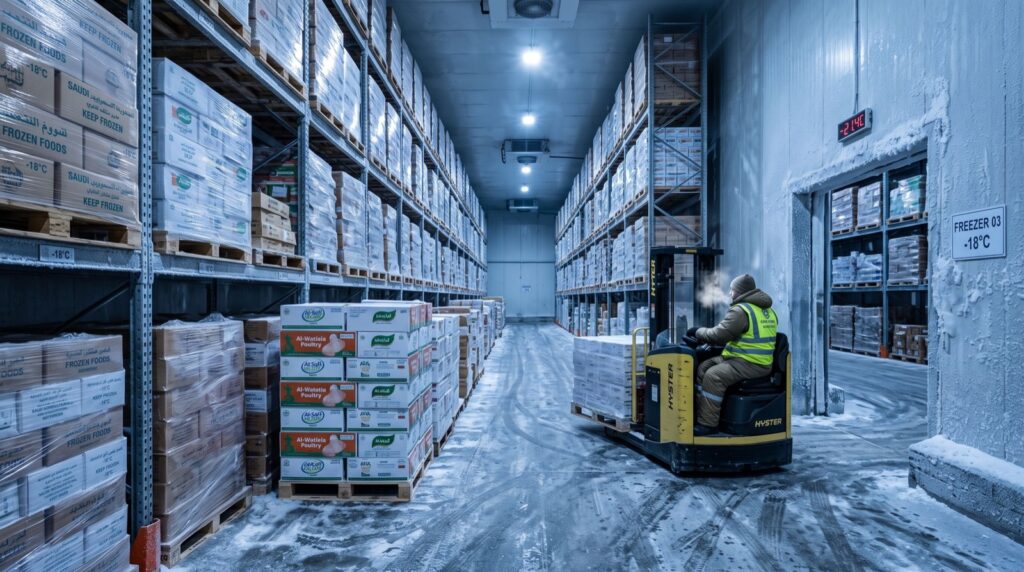
| Frozen | Below -18°C | Highest | Frozen food, ice cream |
| Bonded | Ambient (customs held) | Variable | Imported, duty-pending goods |
For most wholesalers and retailers, ambient space forms the backbone of operations, with smaller specialist zones added only where the product demands it. The GS1 inventory management standards offer a globally recognised framework for barcoding and stock accuracy that pairs well with any ambient setup.
Common Ambient Storage Mistakes to Avoid
Even experienced operators fall into avoidable traps. Watch for these:
- Ignoring humidity because the space feels “cool enough.”
- Stacking pallets too high and crushing lower cartons.
- Blocking fire lanes and emergency exits with overflow stock.
- Skipping cycle counts until inventory drifts out of sync with the system.
- Renting fixed space that cannot flex with seasonal demand.
How Technology Is Reshaping Ambient Warehousing in 2026
Ambient storage may be the oldest format in the industry, but it is far from static. In 2026, even mid-sized Saudi wholesalers are adopting tools once reserved for global giants, and the payoff is measurable.
Barcode and RFID scanning now let a small team track thousands of pallets in real time, cutting the “lost stock” problem that plagues manual warehouses. Cloud inventory systems sync warehouse counts with online storefronts, so a product that sells out online no longer keeps getting promised to customers.
Simple environmental sensors add another layer of protection. A low-cost humidity monitor can text an alert the moment moisture climbs toward the danger zone, letting staff act before cardboard softens or labels peel. For high-value retail stock, that early warning easily pays for itself.
Practical upgrades that deliver fast returns
- Handheld scanners: Slash picking errors and speed up order fulfilment.
- Cycle counting apps: Replace disruptive annual stocktakes with rolling accuracy checks.
- Demand dashboards: Flag slow movers before they become dead stock.
- Humidity alerts: Protect moisture-sensitive packaging automatically.
None of these require a warehouse rebuild. They layer onto existing ambient space and turn a passive store into an active, data-driven asset. Wholesalers who adopt them consistently report fewer stockouts, tighter inventory, and less capital tied up in goods sitting idle on a shelf.
Frequently Asked Questions
What is the difference between ambient and dry storage?
The terms overlap heavily. Both keep goods at room temperature without refrigeration. “Ambient” emphasises natural indoor conditions, while “dry” emphasises low humidity. In practice, a quality facility delivers both: stable temperature and controlled moisture.
Is ambient storage suitable for food products?
Yes, for shelf-stable food such as canned goods, grains, packaged snacks, and dry ingredients. Perishables like dairy, meat, and fresh produce need chilled or frozen storage instead.
How can wholesalers reduce storage costs?
Keep only fast-moving stock close, negotiate flexible contracts, use the 80/20 slotting rule, and rotate inventory to avoid write-offs. Consolidating suppliers into fewer, larger deliveries also lowers handling costs.
Can I scale ambient storage up during peak season?
Yes. Choose a provider offering flexible, short-term expansion so you can add pallet positions before Ramadan or holiday peaks and release them afterwards, avoiding year-round payment for seasonal space.
Conclusion
Ambient storage is not glamorous, but it is decisive. For Saudi wholesalers and retailers in 2026, a well-designed ambient warehouse means full shelves, on-time deliveries, and healthier margins. Match your inventory to the right storage type, slot your fast movers smartly, and choose a flexible partner who grows with you.
Ready to strengthen your supply chain? Audit your SKUs this week, size your baseline space with a seasonal buffer, and lock in flexible ambient storage before your next demand peak. Your shelves, and your customers, will thank you.